Business & Clients
Today's Two Posts Both Keep The Detail With The Trainer, And PT Manager's Radar Wheels Score It For The Client
From the FASTER syllabus: this article is taught in full in PT Manager, free with any FASTER course →
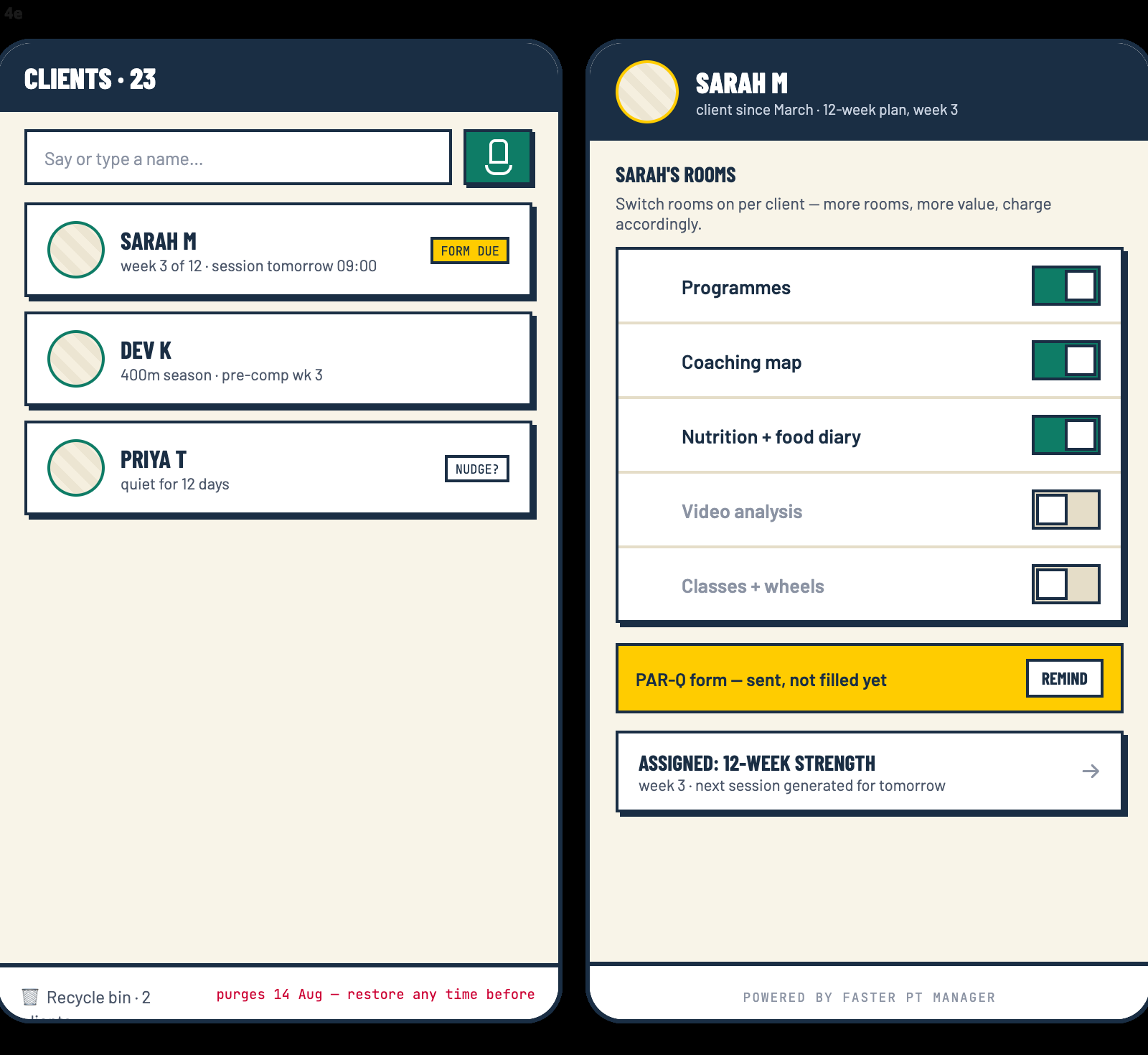
In short: Today's first post ran the four-step method that has now named the exact muscles in twenty different exercises, this time on a single-leg deadlift. Today's second said a client's own attention works best on an external target, not a body part, even though the trainer still needs the detailed picture to coach the movement well. Both keep the fine-grained knowledge with the trainer and hand the client something simpler. PT Manager's Radar Wheels does the same job for a client relationship: a trainer scores up to twenty components out of ten, the three lowest current scores surface automatically as 'the coaching conversation,' and the client sees a score to chase rather than a lecture on every joint behind it. Re-score rounds overlay as coloured shapes so the client can watch the score itself grow over time.
Two posts, one habit
Knowing that a single-leg deadlift asks the glute medius of the standing leg to hold the hip steady is detail a trainer needs and a client doesn't. Pointing that same client at a target to reach, rather than a muscle to think about, is the other half of the same habit: the fine-grained picture stays with the person coaching it, and the person being coached gets something simpler to hold onto. Today's first post built the detailed picture. Today's second said where it should, and shouldn't, go next.
Where PT Manager puts the habit into a client relationship
A trainer who has spent months building up a detailed read of a client, which movements are strong, which are wobbly, what recovery looks like on a bad week, needs somewhere to keep all of it that isn't just memory. PT Manager's Radar Wheels holds up to twenty of those components, scored out of ten, drawn as a spider graph the trainer can look at in one glance. The three lowest current scores surface on their own as the coaching conversation, so the trainer's detailed knowledge decides what matters, and the client is handed one thing to work on, not twenty.
Why keeping the detail apart from the client matters here too
A trainer who tells a client every joint and muscle behind a low score has handed over a lecture. A trainer who says "let's get this one score moving" has handed over a target, the exact shape today's external-targets post was making the case for. Re-score rounds overlay on the same wheel as coloured shapes, so the client watches the actual number grow across weeks, which is a far easier thing to chase than a paragraph of anatomy.
What to do next
PT Manager opens the moment a trainer signs up with any FASTER course, free for life. Today's second post, Movement Trainer (AFT), is where the external-targets teaching behind today's coaching post is taught in full.
The FASTER Journal shares the next teaching point first. Sign up at /newsletter and it arrives the moment it's ready.
You just read one answer. The course is all of them.
PT Manager, free with any FASTER course — taught by the people who wrote it, with free return access for life. The price is on the page, payment plans at checkout, no sales calls.
Also worth a look: Movement Trainer (AFT), today's second post in full.
See what the course covers →Frequently asked
Does the client fill in their own Radar Wheel score?
No, the trainer scores each component from what they see and know about the client. The client sees the resulting shape and the score, which is the simple version of a much more detailed picture.
Why only the three lowest scores?
Naming every low score at once turns a coaching conversation into a checklist. Three keeps it a conversation, and the trainer picks which one to work on first based on what actually matters for that client.
How does this connect to today's earlier two posts?
The single-leg deadlift post named the exact muscles a trainer needs to know to coach the movement well. The external-targets post said the client's own attention belongs somewhere simpler. Radar Wheels is where the detailed version stays with the trainer and the client gets the score.
Reading this for your own training? Every trainer on the FASTER register has been assessed by us — search by town or speciality, free.
Find a FASTER trainer →