
Business & Clients
Adding load only helps if you can see what it's doing to that exact joint, live. Guessing at either one wastes the session
From the FASTER syllabus: this article is taught in full in the PT Manager opens when you sign up with FASTER →
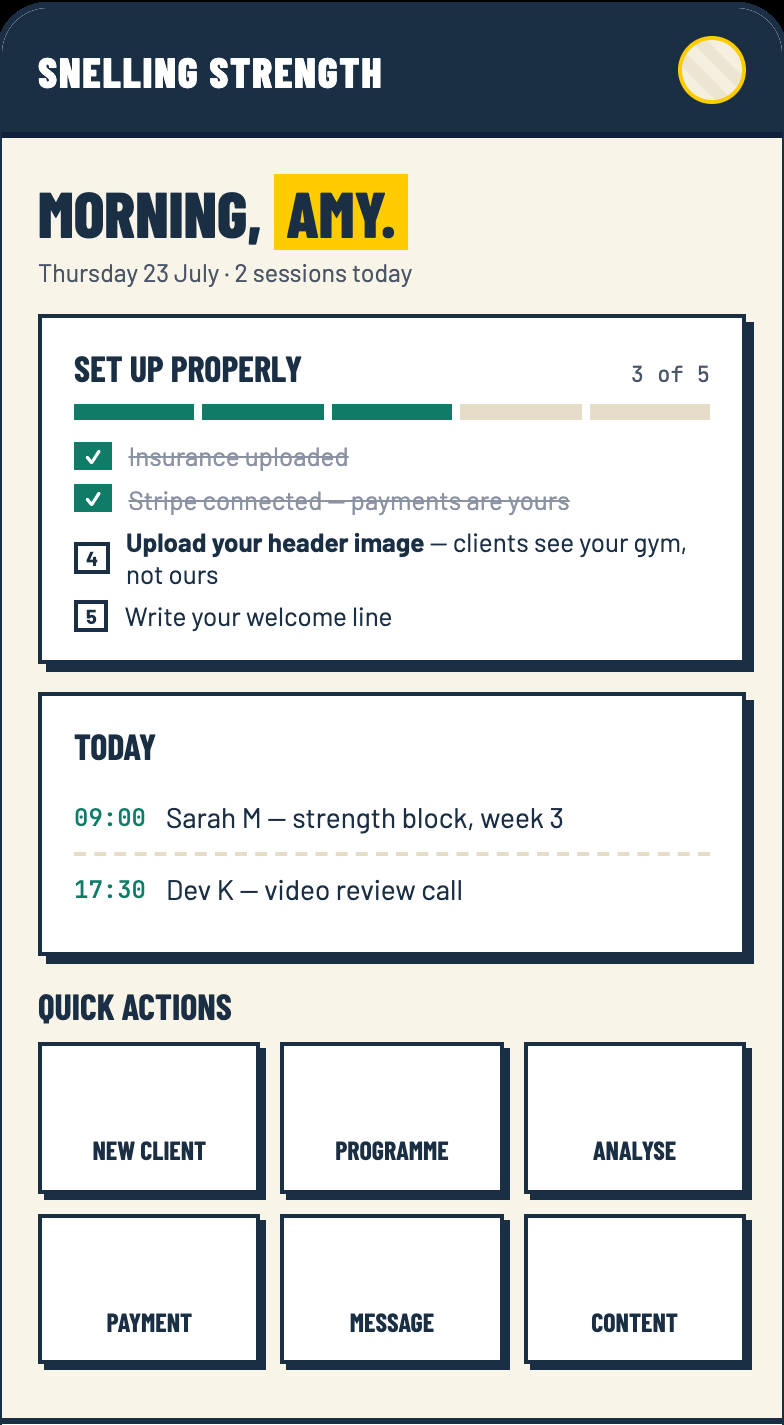
In short: Adding load without watching what it does to that client's specific joints is a guess, and reading a joint without knowing the load behind it is only half the picture. The PT Manager's Live Analyser reads the joint live, and the load log sits one tap away to write down what happened.
The short version
Adding a bit more load only helps a client if a trainer can see what that load is actually doing to their joints, and reading a joint properly only means something once there's a number behind it to track. Two separate skills, and a trainer needs both running at once, not one guessed at while the other gets watched.
Key Takeaways
- Tracking load and reading a client's own joints solve two different problems, and neither one alone is enough.
- The PT Manager's Live Analyser lays a live skeleton over the client and reads the joints during the set, and the client's load log sits one tap away.
- Same camera, same session, both questions answered: watch the joint live, then write what happened against the log.
Two skills, one blind spot
A trainer who tracks load perfectly but never watches the joint doing the lifting can add weight onto a movement that's already breaking down underneath it. A trainer who reads a joint beautifully but keeps no log has no way of knowing if today's set was actually harder than last week's. Both gaps cost a client progress, quietly.
What the Live Analyser actually shows
Point the camera at the client and the PT Manager lays a live skeleton over them, reading joint angle, depth and tempo through the set. The Live Analyser watches; it records nothing. A trainer watching a squat under a new top weight sees the exact rep the depth starts to shorten, and the client's load and reps log in Programme Memory is one tap away, ready to take down what that number just did.
Built on the eye, not instead of it
None of this replaces what Level 2, Level 3 or Field-Based Biomechanics actually teach a trainer to look for. The PT Manager gives that eye a screen readable from across the room, and a load log that doesn't rely on memory, so both skills get used together instead of trading off against each other.
Watched, listened to, or answered back
Nobody gets handed a spreadsheet either. Watch the skeleton move on screen, listen to the cue, or dictate a note after the set, whichever way it actually sticks that day.
Yours from sign-up
The PT Manager opens the moment a trainer signs up with FASTER, ready in their own name straight away. Adding real clients switches on when they pass a course. Starting from scratch, the Certified Personal Trainer course, £1,500 for Level 2 and Level 3, brings it in from day one. Already qualified, the Movement Trainer course or anything above brings a trainer in without repeating what they already know.
The FASTER Journal shares the next teaching point first. Sign up at /newsletter and it arrives the moment it is ready.
You just read one answer. The course is all of them.
the PT Manager opens when you sign up with FASTER — taught by the people who wrote it, with free return access for life. The price is on the page, payment plans at checkout, no sales calls.
Also worth a look: the Certified Personal Trainer course, £1,500, is the way in from scratch.
See what the course covers →Frequently asked
Can the PT Manager track load and read a client's joints at the same time?
In the same session, yes. The Live Analyser reads joint angle, depth and tempo live during the set and records nothing; the client's load and reps log sits in Programme Memory, one tap away, so a trainer watches the joint work and then writes down what happened against it.
Do I need separate tools for programming and movement analysis?
No. One camera and one log cover both, load tracked over time and the joint read live in the same room.
How do I get the PT Manager?
It opens the moment you sign up with FASTER. Adding real clients switches on when you pass a course, from scratch with the Certified Personal Trainer course or already qualified with the Movement Trainer course or above.
Reading this for your own training? Every trainer on the FASTER register has been assessed by us — search by town or speciality, free.
Find a FASTER trainer →