
Coaching & Programming
Put A Client Next To A Wall, And The Movement Slows Down Without A Word From You
From the FASTER syllabus: this article is taught in full in Movement Trainer (AFT), where this lesson lives →
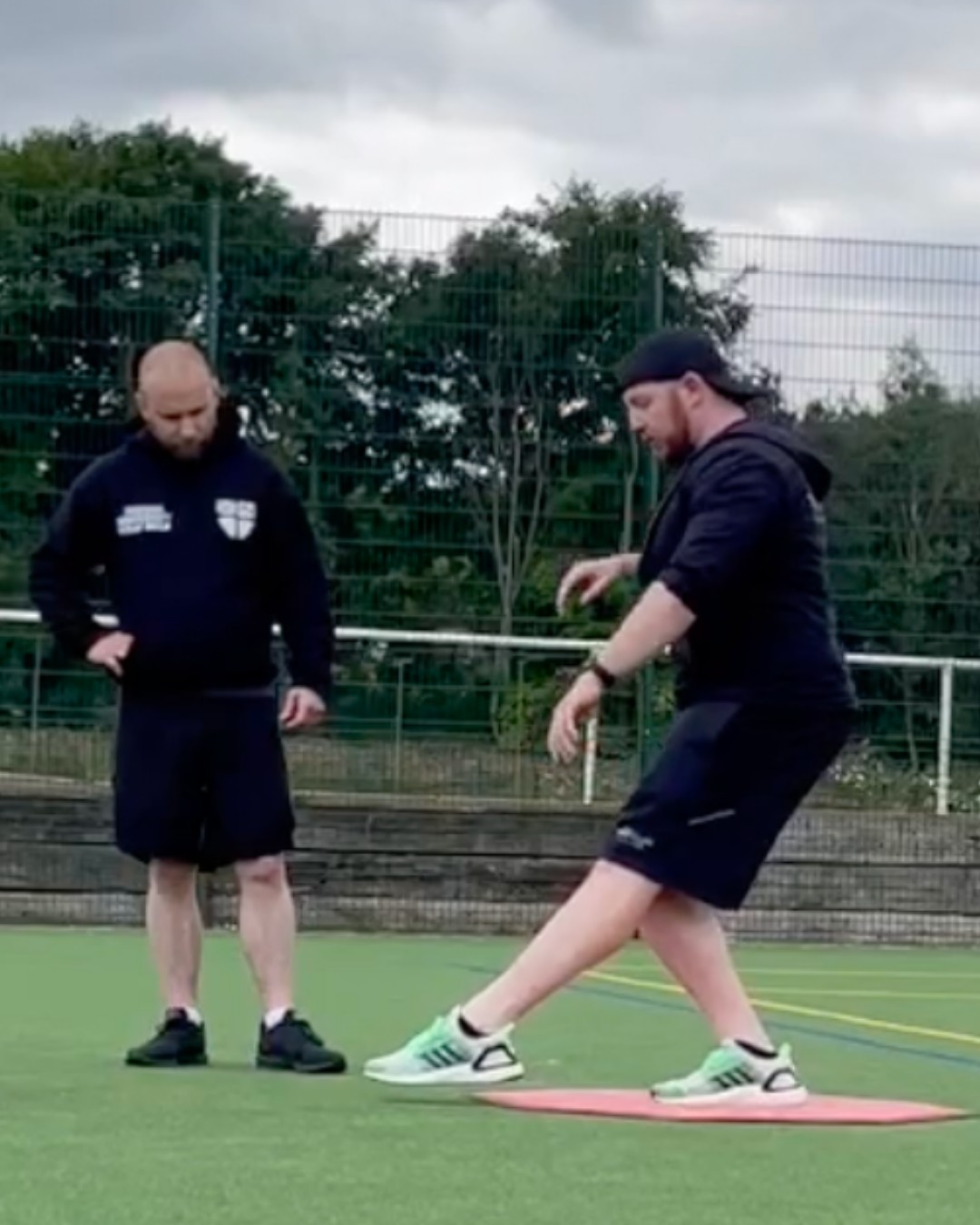
In short: Movement Trainer's speed lesson says changes in speed can make a movement more likely to be successful but less likely to be controlled, or less likely to be successful and more likely to be controlled. The environment is a way to steer that without another cue: put an exercise near a wall to reduce movement, put a client in a box of cones to reduce speed, create more peril (stay on a line) to slow an exercise down, use a gradient to speed it up or slow it down, position yourself or a hand in the space to block a degree of freedom, or add a training tool that guides a successful motion. Each one changes how the client moves by changing the space, so the trainer has fewer words to find.
Speed is a trade, and the space around a client sets the price
Movement Trainer's lesson on speed opens with one sentence worth keeping: changes in speed can make a movement more likely to be successful but less likely to be controlled, or less likely to be successful and more likely to be controlled. Fast and messy on one side, slow and tidy on the other, and a trainer can choose where a session sits.
Six things a room can do
The next part of the lesson is all about the environment. Creating an environment that influences movement is a good way of making sure a client moves the way you would like them to, by restricting degrees of freedom, or by building up an abundance of movements through different challenges. The course lists what that looks like:
- Put an exercise near a wall to reduce movement. The wall takes away the room a client would otherwise use.
- Put a client in a box of cones to reduce speed. Nobody sprints inside a box of cones.
- Create an environment with more peril, such as staying on a line, to slow an exercise down.
- Use a gradient to speed an exercise up or slow it down.
- Position yourself or your hand in the space to prevent a client from using a degree of freedom.
- Add a training tool that guides a successful motion.
Why this is friendly to the trainer
Every item on that list is a change to the space, so none of them needs a clever sentence. A trainer who has run out of ways to say "slower" can move the cones instead. A client who keeps drifting wide gets a wall, and the drift stops without being mentioned. It is kind to the client too, because nothing about it sounds like being told off.
It also works in both directions. The same list that slows a movement down can be turned around, with a gradient or a bit less peril, to let a client speed it up and find how much of the movement they own.
Where this sits in the course
This is one lesson from Movement Trainer (AFT), the FASTER course for trainers who already hold a qualification and want a system for movement, programming and feedback. The Movement Trainer course page has the full list of what it covers, taught through reading, listening, video and written or dictated answers, so there is a way in for every kind of learner.
PT Manager opens the moment you sign up with any FASTER course, and adding real clients unlocks the day you pass one.
The FASTER Journal shares the next teaching point first. Sign up at /newsletter and it arrives the moment it's ready.
You just read one answer. The course is all of them.
Movement Trainer (AFT), where this lesson lives — taught by the people who wrote it, with free return access for life. The price is on the page, payment plans at checkout, no sales calls.
Also worth a look: PT Manager, free with any FASTER course.
See what the course covers →Frequently asked
Does changing the environment replace coaching cues?
It gives the trainer a quieter option. Where a cue asks the client to think about a movement, a wall or a line changes the movement without asking for anything.
Is faster always worse for control?
The course text puts it as a trade. More speed can make a movement more likely to succeed and less likely to be controlled, and less speed can do the opposite, so the trainer picks which one the session wants.
Where is this taught?
In Movement Trainer (AFT), on FASTER's own course text for speed and the environment, and PT Manager opens the moment you sign up with any course.
Reading this for your own training? Every trainer on the FASTER register has been assessed by us — search by town or speciality, free.
Find a FASTER trainer →