Biomechanics
Five ways to get movement at one joint
In short: Any joint action can be produced five ways: distal segment moving, proximal segment moving, distal faster, proximal faster, or both segments moving in opposite directions. The joint angle is the same in all five; the demand on the body is not.
Hip flexion is hip flexion, according to the exam paper. The thigh comes closer to the trunk, tick the box, next question. Out in the world, that one joint action happens five different ways, and a client's hips meet all five before lunch.
Take the hip. The femur can swing up towards a still pelvis, which is a knee raise. The pelvis can tilt over a still femur, which is the top of a hinge. Both can move with the femur doing most of it, both can move with the pelvis doing most of it, and the two can move in opposite directions at once, which is what happens on the back leg mid-stride. Five ways. Same joint, same named action, one identical angle at the joint every time.
The difference is everything the angle does not capture. Which muscles work, which end of the chain has to control itself, what the rest of the body does to allow it, and what the nervous system learns. A pelvis tilting over a fixed femur teaches control the knee raise never asks for.
The five, named plainly
Distal moving: the far end travels, the near end holds. Proximal moving: the near end travels, the far end holds. Distal faster: both travel, the far end wins. Proximal faster: both travel, the near end wins. Opposite directions: the two ends pass each other. That is the whole list, and it applies to every joint in the body, from a big hip down to the joints of the foot.
Most gym programmes live almost entirely in the first one. The bar or the hand or the foot moves, the body stays put. It works, and it can stay. The other four are where an enormous amount of real-world capability hides, and they cost nothing to programme once they have names.
Watching it instead of imagining it
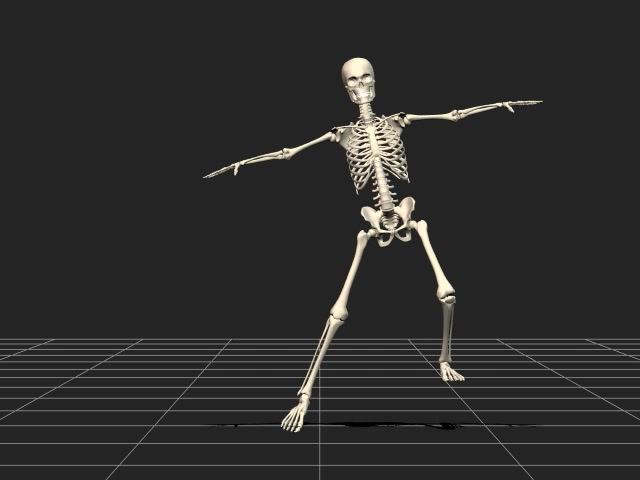
Reading the list is one thing. Watching a skeleton do all five at the same joint is what makes it stick, which is why the FASTER Movement Model's joint school now has a which-end-moves control: pick a joint, pick an action, and flick between all five ways while the anatomy performs them. The filmed skeleton series behind it covers the hip and knee action by action.
The model lives in the PT Manager: https://www.fasterfunction.com/pt-manager
Frequently asked questions
Why does the same joint angle feel so different between versions?
Because the work moves. When the proximal segment travels, the muscles controlling it work harder and everything stacked above it has to organise itself differently. The joint angle is a geometry fact; the effort distribution is a coordination fact.
Which of the five should a beginner start with?
Whichever the goal task uses. Walking already uses opposite directions at the hip; standing up already uses proximal moving. Beginners are not fragile, and the five ways are not a progression ladder, they are a coverage checklist.
Does this apply to the spine too?
Completely. A cervical spine can move the head on a still trunk or the trunk under a still head, and the difference matters for everything from heading a football to reversing a car.
One plain idea like this lands on the FASTER mailing list every week: https://www.fasterfunction.com/newsletter
Reading this for your own training? Every trainer on the FASTER register has been assessed by us — search by town or speciality, free.
Find a FASTER trainer →