Coaching & Mindset
Bits of paper, a pile of Google Docs, or £60 a month. Programming for clients deserves better
From the FASTER syllabus: this article is taught in full in see the PT Manager programming room →
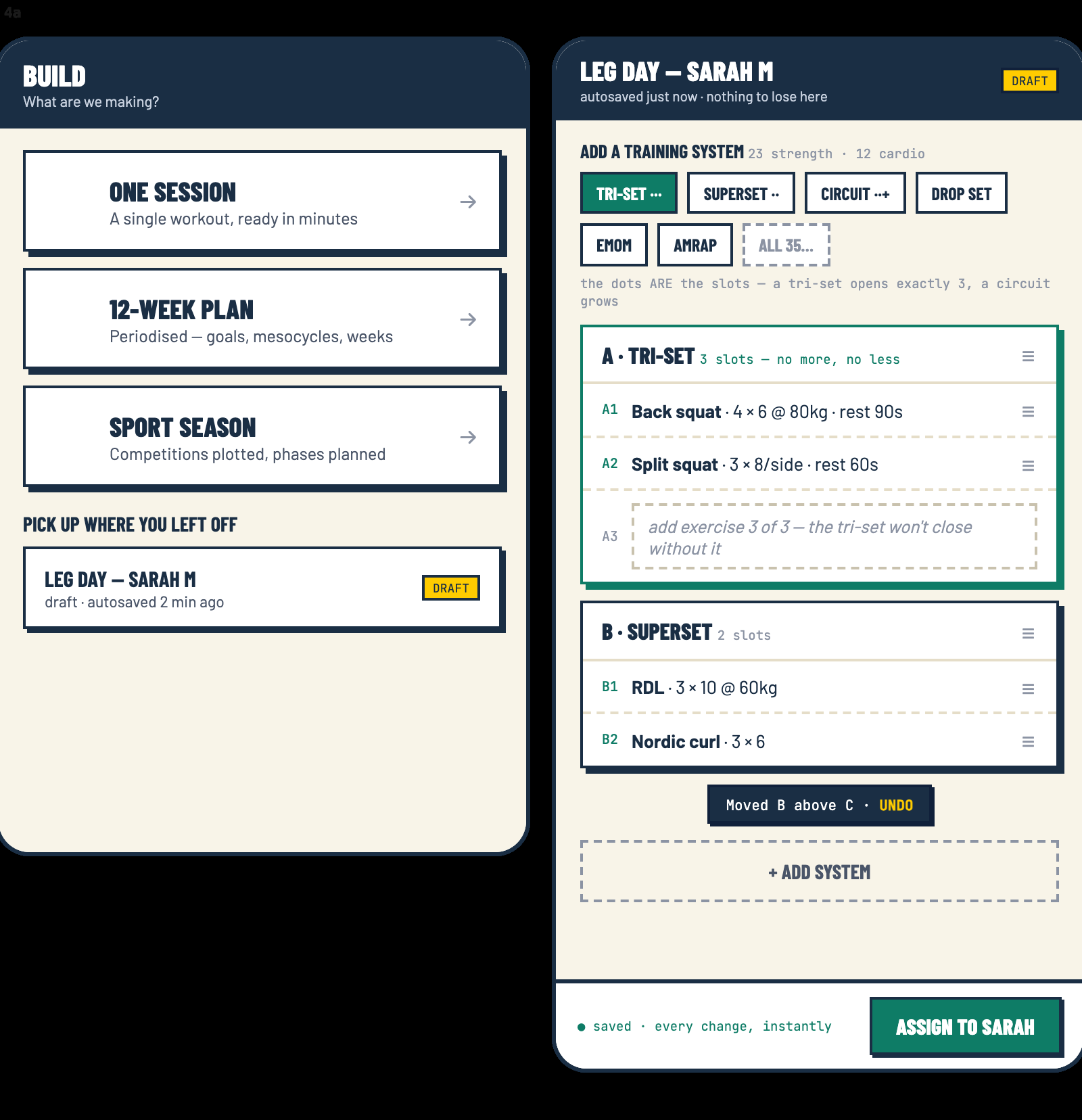
In short: Bits of paper, numerous Google Docs or £60 a month, and there is still no easy way to programme for a client. Skeletons and Blocks is the FASTER answer: skeletons are the vaguely designed layout, blocks are the specific deliverables inside it, and exercises come last. It mimics the pattern of the best programmes and turns it into consistent training a client loves. It lives in the PT Manager, and the first module of the Motor Skill Application Specialist is dedicated to it.
The short version
Bits of paper, numerous Google Docs or £60 a month, and there is still no easy way to programme for a client. Building a programme should be easy. Tracking progress should be easy. A client should be able to help with both, easily. The industry doesn't provide for that, or wants its pound of flesh to try.
Key Takeaways
- Skeletons and Blocks is the FASTER way of building programmes: the skeleton is the vaguely designed layout, blocks are the specific deliverables inside it, and exercises come last.
- It works by mimicking the best programmes — found online or written for a client — highlighting their pattern, then training the client in a consistent fashion they love.
- Programmes run home-based without supervising, while the trainer keeps a card the client doesn't see, taken into the session and adapted live.
- The Motor Skill Application Specialist dedicates the first module of the course to this one task.
The pattern under a great programme
I designed Skeletons and Blocks for FASTER as a way of mimicking the best programmes — the ones found online, or the ones a trainer writes for a client — highlighting their pattern, and then handing over the tools to train the client in a consistent fashion that they love. The skeleton is just the vaguely designed layout. The blocks, which honestly should have been called bones, are the more specific deliverables inside the skeleton. Exercises are the last part really.
That order matters. Most programming falls apart because it starts at the exercise and works backwards, which is how a folder of one-off sessions gets born. Start at the pattern and the programme stays consistent from week to week, and consistency is the thing clients actually feel and stick with.
Built to pass the thinking on
The system exists to pass on years of programme-writing research and experience, in a form that is easy to use and easy to hand to a client. It is also something a trainer can learn to earn with: the same structure that makes a programme quick to build makes it quick to distribute, so one trainer's thinking reaches many clients without the quality slipping.
The card the client never sees
A programme built this way runs home-based, without the trainer supervising. Meanwhile the trainer keeps their own card, the one the client doesn't see, taken into the session and adapted on the spot. The client gets consistency; the trainer keeps the freedom to read the person in front of them and change the plan live. Both halves live in the PT Manager, and the client can help with the tracking side, easily, because it was designed for them to.
Where to learn it
A great place to learn how to do this is the Motor Skill Application Specialist, where the first module of the course is dedicated to this one task. Like everything at FASTER it can be read, watched, written or spoken aloud, whichever way it sticks. The PT Manager opens in a trainer's own name on sign-up, so the building can start straight away.
The FASTER Journal shares the next teaching point first. Sign up at /newsletter and it arrives the moment it is ready.
You just read one answer. The course is all of them.
see the PT Manager programming room — taught by the people who wrote it, with free return access for life. The price is on the page, payment plans at checkout, no sales calls.
Also worth a look: the Motor Skill Application Specialist dedicates its first module to this.
See what the course covers →Frequently asked
What are Skeletons and Blocks?
The FASTER way of building programmes. A skeleton is the vaguely designed layout of a session or programme; blocks are the more specific deliverables inside the skeleton; exercises are the last part. Together they capture the pattern of a great programme so it can be reused and adapted per client.
Can clients train from it at home?
Yes. A programme runs home-based without the trainer supervising, and the trainer keeps their own card the client doesn't see, taken into the session and adapted live.
Where can I learn to build programmes this way?
The Motor Skill Application Specialist dedicates the first module of the course to exactly this task, and the PT Manager is where it gets used.
Reading this for your own training? Every trainer on the FASTER register has been assessed by us — search by town or speciality, free.
Find a FASTER trainer →