Business & Clients
Adapting Today's Session and Building the Route Back to Performance Are the Same Job, and PT Manager Holds Both
From the FASTER syllabus: this article is taught in full in PT Manager, free with any FASTER course →
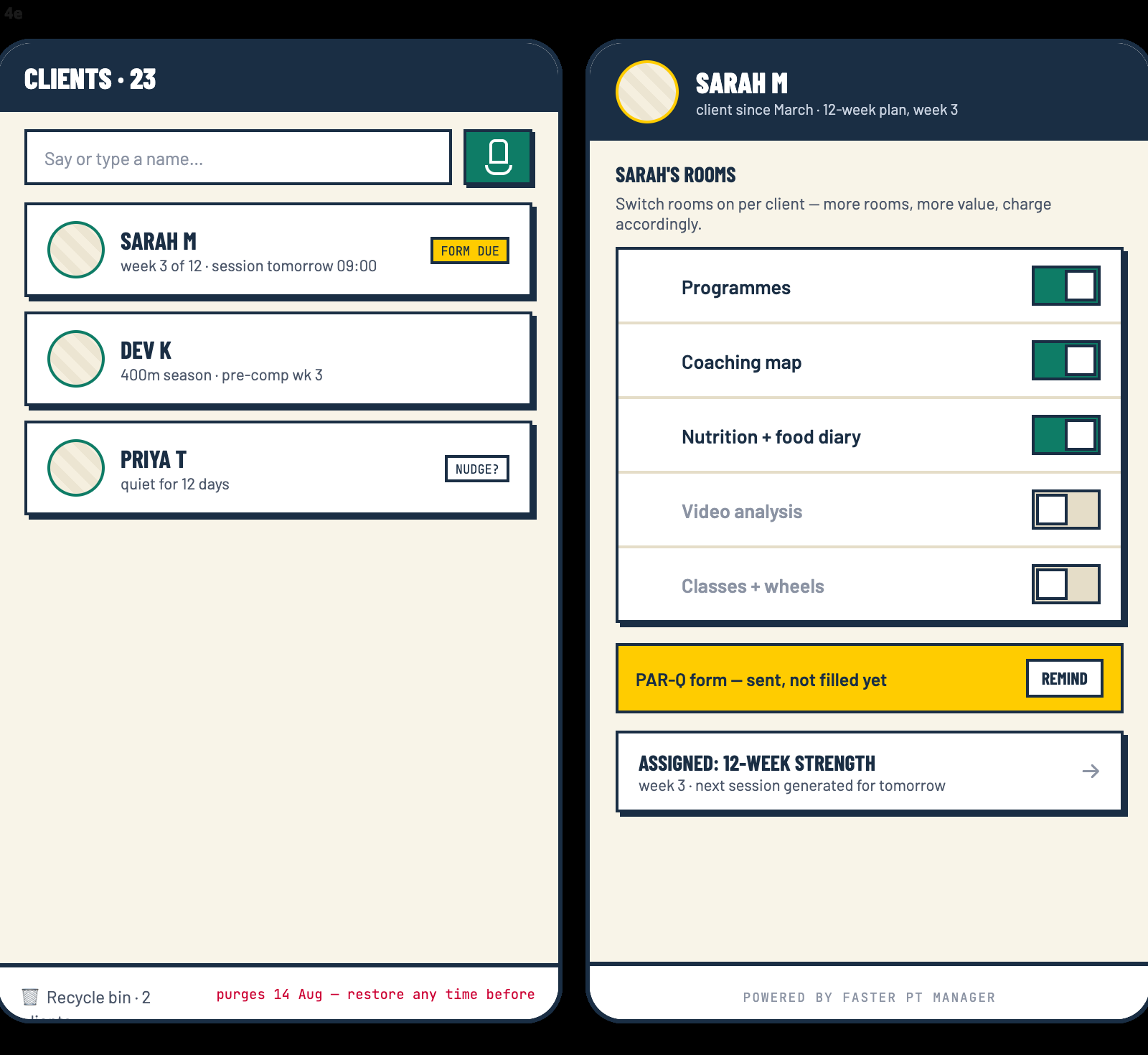
In short: PT Manager's client records room holds which of the six client states a trainer adapted for, session to session, so a client's route from recovery back to performance shows up as a visible trend rather than a memory a trainer has to trust.
Adapting Today's Session and Building the Route Back to Performance Are the Same Job, and PT Manager Holds Both
The short version
Today's earlier posts covered two things that connect. One named six states a session should adapt to, sedentary through to sport-specific performer. The other, Injury Recovery to Performance Specialist, builds the skill of moving a client through one of those states, recovering from injury, all the way back to performance. PT Manager's client records room is where that whole journey stays visible, not remembered.
Key Takeaways
- Which of the six states a client is in today, and how they're progressing, is exactly what PT Manager's client records hold against their name.
- Session history sits there week to week, so a route from recovery to performance shows up as a trend rather than a guess from memory.
- PT Manager opens at sign-up. Adding real clients unlocks once a course is passed, the Certified PT course from scratch, or a specialist course like Injury Recovery to Performance if you're already qualified.
Where the six states get written down
A trainer working from today's first post checks a client against six states before building a session. PT Manager's client room is where that check stops living only in a trainer's head, name, notes and history sitting against each client, session to session.
Watching recovery become performance
A client working through Injury Recovery to Performance moves in stages, over weeks, not one session. The client records room holds that trajectory, so the trainer running session forty can see what session one looked like, instead of guessing how far things have come.
How it opens up
PT Manager opens the day you sign up with FASTER, so you can explore it and build it around your own business straight away. Adding real clients unlocks once you've passed a course, whichever route got you there, the Certified PT course from scratch, or a specialist course like Injury Recovery to Performance if you're already qualified and don't need to repeat Level 2/3.
What to do next
If today's first post on the six client states landed, the Certified PT course builds that checklist in from the start. If the second post on Injury Recovery to Performance was the one, that's the deeper skill for the client cleared but still carrying something. Either way, PT Manager runs from the moment you sign up and holds the record of both.
The FASTER Journal shares the next teaching point first. Sign up at /newsletter and it arrives the moment it's ready.
You just read one answer. The course is all of them.
PT Manager, free with any FASTER course — taught by the people who wrote it, with free return access for life. The price is on the page, payment plans at checkout, no sales calls.
Also worth a look: Injury Recovery to Performance Specialist, today's second post in full.
See what the course covers →Frequently asked
Does PT Manager decide which of the six states a client is in?
No, that's the trainer's call from today's earlier post. PT Manager holds the record of that call and what was built from it, session to session.
Do I need Injury Recovery to Performance Specialist specifically to add clients in PT Manager?
No. Any completed FASTER course unlocks it, the Certified PT course from scratch, or a specialist or Expert course like Injury Recovery to Performance if you're already qualified.
What actually sits in the client records room?
Each client by name, session history, and the notes and adaptations a trainer has made for them over time, so the reasoning behind a session survives past the moment it happened.
Reading this for your own training? Every trainer on the FASTER register has been assessed by us — search by town or speciality, free.
Find a FASTER trainer →