Become a Personal Trainer
What Muscles Work In A Press-Up, And How To Work It Out For Any Exercise
From the FASTER syllabus: this article is taught in full in The honest route from scratch to qualified →
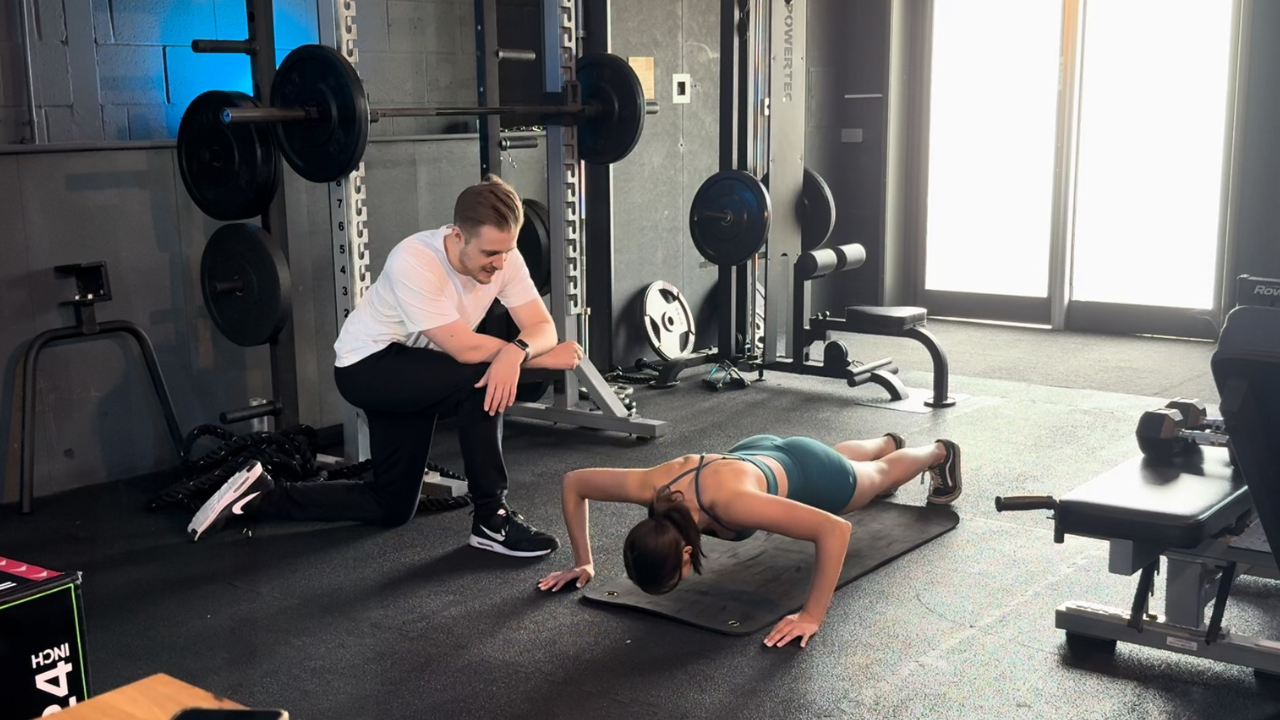
In short: A press-up works the pectoralis major, triceps brachii and anterior deltoids as the prime movers, lengthening on the way down and shortening to press back up. The serratus anterior assists by protracting the shoulder blade at the top of the movement, and the core — rectus abdominis, obliques and glutes — supports the whole thing by holding the body in a straight line, so the force travels through the arms instead of leaking through a sagging back. The four steps that produce that answer are: decide where the force is acting, find the muscles working directly against it, find the muscles assisting, then find the muscles supporting the joint — the same four steps that answered the same question about a squat, a lunge and a deadlift.
What muscles work in a press-up
The pectoralis major, triceps brachii and anterior deltoids doing the pressing. The serratus anterior finishing the movement at the top. The core holding the body in a straight line so none of that effort gets lost on the way to the floor.
That's the answer. Like the squat, the lunge and the deadlift before it, it came from a method rather than a memorised list, and the method is the part worth having.
Four exercises in, and the fourth step keeps deciding the post
A squat, a lunge and a deadlift have all run through the same four steps. One of the things you learn on our CIMSPA-recognised personal training course is that the method doesn't change from exercise to exercise, only the answer does:
- Decide where the force is acting on the body
- Identify which muscles work directly against that force (muscles that lengthen are easiest to see)
- Identify which secondary muscles assist that movement
- Identify which muscles would support that joint / movement
Run it on a press-up.
One, where is the force acting? Straight down through the trunk, from a body held rigid, transmitted into the ground through the hands. The body moves as one piece, pivoting at the shoulders and hips together.
Two, what works directly against it? The pectoralis major, triceps brachii and anterior deltoids. They lengthen as the chest lowers toward the floor, then shorten to press the body back up, doing most of the visible work of the movement.
Three, what assists? The serratus anterior, protracting the shoulder blade around the ribcage at the top of the rep. It's the extra reach that gets the chest fully away from the floor, and usually the first thing that goes missing when a press-up gets rushed.
Four, what supports? This is where a press-up's answer stops looking like a squat's. There's no separate joint being held here, it's the whole body. The rectus abdominis, obliques and glutes hold the trunk and hips in one straight line, so the force the arms are producing reaches the floor instead of leaking out through a hip that drops or a back that sags.
Why that fourth answer is worth having
A trainer who only knows "press-ups work the chest and arms" has nothing useful to say when a client's lower back complains before their arms do. A trainer who has run the four steps can say plainly that the pressing muscles might be doing their job perfectly well, and the sag is a support job, the core not holding the line, rather than a pressing one.
Point it at anything
A plank, where steps one to three barely apply and step four is almost the entire exercise. A Pallof press, where the "support" muscles are resisting rotation instead of holding a straight line. Any exercise built around holding a position rather than moving through one puts nearly all its work into that fourth question.
What to do next
The whole route from no qualification to working trainer is set out at become a personal trainer. It sets out what Level 2 and Level 3 contain, what it costs, and how long it takes. The price is on the page, there are no sales calls, and free lifetime return access is included, so the anatomy unit is still there the week a client asks about an exercise you haven't thought about since the exam.
The anatomy unit itself sits in Level 3 Personal Trainer, and in the Certified PT Bundle at £1,500 alongside Level 2 and Movement Trainer.
The FASTER Journal shares the next teaching point first. Sign up at /newsletter and it arrives the moment it's ready.
You just read one answer. The course is all of them.
The honest route from scratch to qualified — taught by the people who wrote it, with free return access for life. The price is on the page, payment plans at checkout, no sales calls.
Also worth a look: Level 3 Personal Trainer — the anatomy unit this comes from.
See what the course covers →Frequently asked
Why does a press-up put so much of the fourth step on the core?
Because the body has to stay a straight line from shoulder to ankle for the whole rep, and that holding job falls to the core rather than the arms or chest.
If someone's back sags on a press-up, is that an arm problem?
Not usually. The prime movers can be plenty strong while the fourth step, the support job, isn't being done, which is a core-holding issue, not a pressing one.
Does finishing the course get me PT Manager?
Yes. PT Manager opens the moment you sign up with FASTER, and adding real clients unlocks once you pass a course.
Reading this for your own training? Every trainer on the FASTER register has been assessed by us — search by town or speciality, free.
Find a FASTER trainer →