Become a Personal Trainer
What Muscles Work In A Vertical Jump, And How To Work It Out For Any Exercise
From the FASTER syllabus: this article is taught in full in The honest route from scratch to qualified →
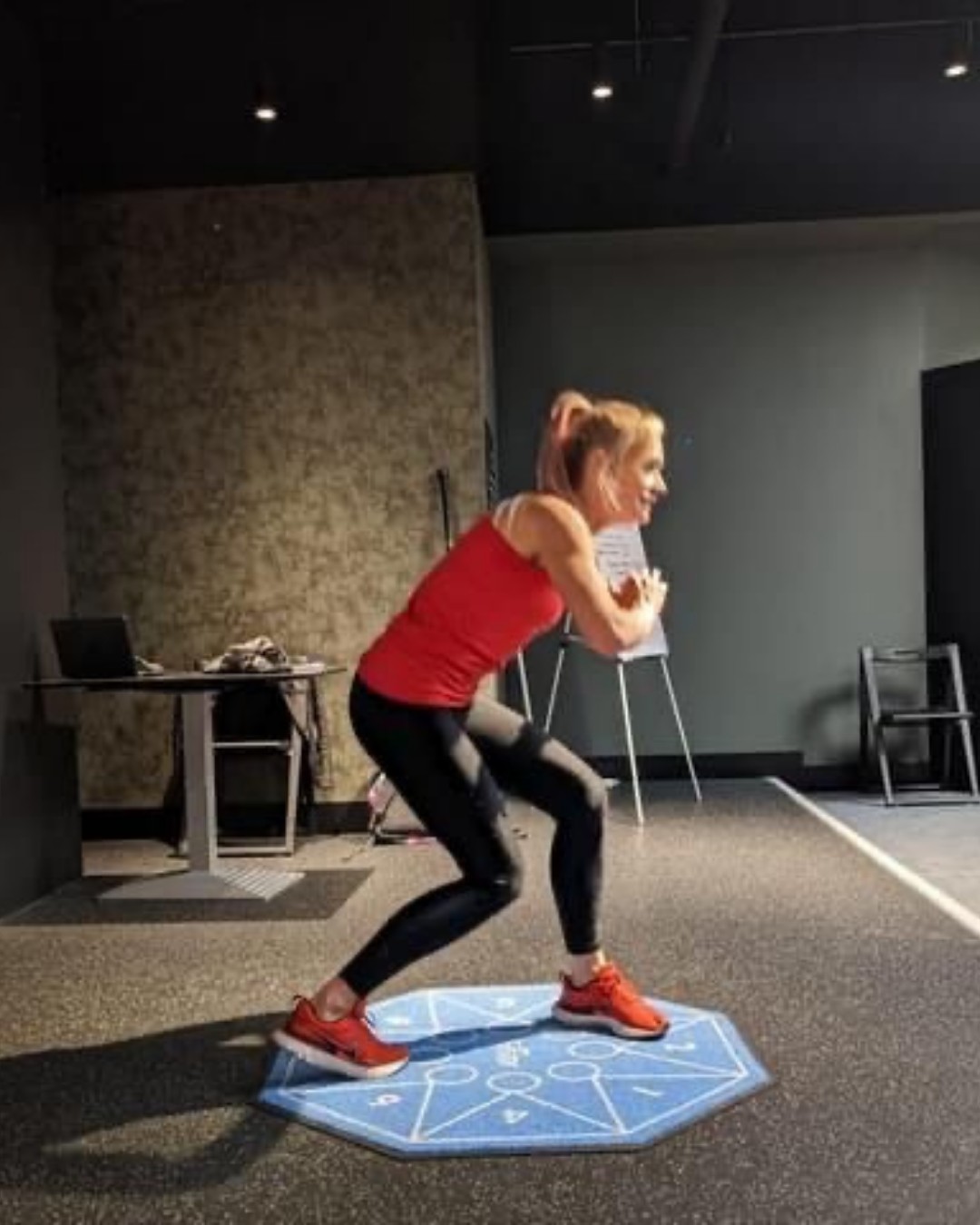
In short: A vertical jump is driven by the glutes and quads, loading through the dip and then firing hard to open the hips and knees, finished by the calves through the ankle at the very top of the drive. The hamstrings help the glutes finish hip extension, and the hip flexors help arrest the dip and reverse it. The core keeps the trunk stacked so none of that drive leaks out sideways, and the smaller muscles around the ankle and knee take the same force back in on the landing. The four steps that produce that answer are: decide where the force is acting, find the muscles working directly against it, find the muscles assisting, then find the muscles supporting the joint, the same four steps that already answered the same question about a squat, a lunge, a deadlift, a press-up, a row, a shoulder press, a loaded carry, a suspended plank, a sprint and a medicine ball throw.
What muscles work in a vertical jump
The glutes and quads, lengthening through the dip and then firing hard to drive the hips and knees open. The calves, finishing the job through the ankle right at the top, adding the last bit of height once the legs are already extending. The hamstrings, helping the glutes finish hip extension, and the hip flexors, helping arrest the dip and reverse it into a drive. And the core and the smaller muscles around the ankle and knee, holding the trunk so the drive doesn't leak out sideways, then taking the same force back in on the way down.
That's the answer, and like the squat, the lunge, the deadlift, the press-up, the row, the shoulder press, the loaded carry, the suspended plank, the sprint and the medicine ball throw before it, it came from a method rather than a memorised list.
Nobody's taken a client yet, and that's fine
Somebody weighing up a career change into personal training can watch a vertical jump on a phone and file the whole thing under "explosive," which tells them almost nothing useful about what's actually happening between the dip and the ground. One of the things you learn on our CIMSPA-recognised personal training course is a method that turns that vague word into a specific list of muscles, each doing exactly the job it's built for, in the quarter-second between loading and leaving the floor.
Eleven exercises in, and the method still hasn't changed
A squat, a lunge, a deadlift, a press-up, a row, a shoulder press, a loaded carry, a suspended plank, a sprint and a medicine ball throw have all run through the same four steps:
- Decide where the force is acting on the body
- Identify which muscles work directly against that force (muscles that lengthen are easiest to see)
- Identify which secondary muscles assist that movement
- Identify which muscles would support that joint / movement
Run it on a vertical jump.
One, where is the force acting? Downward, through the feet and into the floor, as the body drops into the dip and then drives back up against it.
Two, what works directly against it? The glutes and the quads, lengthening under load through the dip and then contracting hard to open the hips and knees, and the calves, finishing the drive by pointing the ankles right at the top of the movement.
Three, what assists? The hamstrings, helping the glutes finish hip extension, and the hip flexors, helping arrest the dip at the bottom and whip the legs back through the reversal.
Four, what supports? The core, keeping the trunk stacked so the leg drive doesn't leak out sideways or through a rounding back, and the smaller muscles around the ankle and knee, controlling the landing by absorbing the same force in reverse.
Why that fourth answer is worth having
A trainer who only knows "jumps build power" has nothing specific to watch for when a client's landing looks loud or their knee drifts inward on the way down. A trainer who has run the four steps is watching the ankle and knee stabilisers specifically, which is usually where a jump starts looking sloppy long before the height itself drops off.
Point it at anything
A broad jump, where the same dip-and-drive happens but the force is sent forward instead of straight up. A box jump, where the landing muscles get an easier ride but the take-off asks exactly the same question of the glutes and calves. A jump onto one leg, where the ankle and knee stabilisers on that side are doing the whole landing job alone instead of sharing it. Any explosive, ground-based movement a client already does can be answered the same way, without a new list to learn.
PT Manager opens the moment you sign up with any FASTER course, and adding real clients unlocks the day you pass one. Read more about the Level 3 Personal Trainer Certificate this method comes from.
FASTER Daily News sends you each day's blog links, the latest on new courses and live opportunities, and updates to PT Manager, free for students. Sign up at /newsletter.
You just read one answer. The course is all of them.
The honest route from scratch to qualified: every answer marked by a real tutor, with free return access for life. The price is on the page, payment plans at checkout, no sales calls.
Also worth a look: Level 3 Personal Trainer — the anatomy unit this comes from.
See what the course covers →What every FASTER student gets
Built around you, not around the course
- A real person marks every answerEvery answer is read and marked by a tutor, with written feedback.
- Marked as you goEach teaching point is marked as you answer it, not at the end of the module.
- Dictate instead of typeA microphone on every written answer: say your answer and it types it for you (Chrome, Edge and Safari).
- Listen to the lessonsVoice-overs on the lessons, and the audio to download.
- Built for the way your brain worksShort lessons, one point at a time, marked as you go, with the choice to listen, read, print or speak your answers.
- Streaks that never punish youYou set how many days a week you want to study. Miss a day and your streak pauses; it is never lost.
- Accessible to WCAG AA, with an AAA optionEvery page measured against the WCAG accessibility standard: no faults at level A or AA, with a skip link, screen-reader labels and pages that hold together zoomed to 400%. A high-contrast option takes it to AAA.
- Keep it plainOne switch turns off the extras, the streaks, the badges, the celebrations and the movement, so the site stays plain and calm. Switch them back on whenever you like.
- Bigger text and wider spacingTwo steps of bigger text, and more room between lines, words and letters, on every page.
- Calmer motionOne switch stops animations and videos that play on their own. It is on already if your phone or computer asks for reduced motion.
- A personal video lessonWhen an answer needs real explaining, your marker records a video that lands in your course.
- A note before you sendBefore you send, the page tells you if your answer copies the lesson word for word, so you can put it in your own words.
- The skeleton and muscle labsTap any bone on the skeleton, and see the muscles light up on the model.
- Print the notesPrint the lessons and go old school.
- Case studies on your phoneBuilt into the site, saved as you go, there on your laptop when you sit down.
- Pin it to your home screenNo App Store and no Google Play. It is just there.
- No resit feesWork sent back is a chance to add more, with no resit fee.
- Return access for lifeQualify once and come back to the content whenever you need it.
- PT Manager from day onePT Manager is yours to learn on from the day you sign up. Using it with real clients comes once you hold your Level 3 and are listed on the FASTER Trainer Register.
- The FASTER Trainer RegisterA free listing on the Register once you qualify.
- Your certificates in one placeEvery course and its certificate on one page.
- Ask JohnThe Ask John button on every page, and his WhatsApp.
And PT Manager, free
52 tools to run your business, with no monthly fee and no cut of your money
PT Manager is yours to learn on from the day you sign up. Using it with real clients comes once you hold your Level 3 and are listed on the FASTER Trainer Register.
See all 52 tools
Set-up
- Import clients Bring a whole client list across in one go.
- My quotes Daily lines your clients see — yours, not stock.
- Programme templates The programme shapes you reuse — a session or twelve weeks. Pick one for a client, get your own copy.
- Exercise library Every exercise with FASTER coaching detail.
- Money Products, payments and who owes what.
- Send from your own email Connect your own email service so invites arrive from you, on your domain.
- My brand & client view What your clients see when they walk in — views, header, accent, logo.
- Your enrolment pack What every new client gets the moment you enrol them — your forms, ours, or a mix.
- Products and services What you sell — blocks, packages, memberships and one-offs, with their prices.
- Insurance Your policy on record — provider and expiry. Client features unlock while it is valid.
- My menu Switch any tool on or off — for your menu, your home and your whole account.
- Your website A free website on your own web address, filled from PT Manager. Or just the client sign-in door on your domain.
- Your public page Your verified Trainer Register listing, linking out to your own site and socials.
Business day to day
- Clients Your client list — invite, open a client, manage their space.
- Clubs Group your clients — a board they share, a programme or a monthly price if you want one.
- Challenges A dated push everyone logs against — for everyone you train, or for one club.
- Calendar Sessions, classes, capacity and bookings.
- Reminders The dates your business can't let lapse — insurance and first aid, nagged ahead of time.
- Nudges Who needs a nudge today — opportunities, one tap each.
- Who needs chasing Every conversation about money, in the order to work through them.
- What needs doing Your own list, in your own words — the jobs you keep meaning to get to.
- Till Sell at the desk — cash, card or on their phone — and download the sales sheet.
- What you are making What is coming in every month, what was paid in the last 30 days, and what sells.
Templates and systems
- Forms & interviews PAR-Q, consent, consultations and your own forms.
- Coaching room The coaching tools shelf — wheels, journeys and resources in one place.
- Radar wheels Build a life or performance wheel a client fills in — see change over time.
- Nutrition by FASTER Nutrition sheets and habits without meal-plan pretence.
- Pathways Automated coaching journeys you assign to clients.
- Programmes Start a programme — a session, a month, 12 weeks or a season — and find the ones you have built.
- Games & drills planner Build game-based sessions and drills.
- Sport screens Pick a sport — the shots to film, the analyser, and a ready-made radar of the qualities that matter.
- Movement screen → radar Read joint angles off the analyser — they auto-score and fill a radar wheel.
- Assessment builder Build and run client assessments and re-tests.
- Tag analytics Every tag across your clips, grouped and exportable.
Client
- AI prompts Your reusable prompt library for coaching copy.
- Workout library Short workouts your members put together by how they feel and how long they have.
- Before & after Side-by-side progress comparisons.
Trainer tools
- Exercise generator Fresh exercise ideas from constraints you set.
- FASTER dice & wheel Spin-and-roll session variety for groups and games.
- Movement demonstrator A 3D model of the FASTER movement patterns — body or skeleton view, prime movers lit up, live joint angles.
- Client video analysis Your media library — client folders and your own. Pick a clip to analyse.
- Movement by FASTER (HMAC) Human movement analysis charts — see how a client moves.
- Live analysis Mount your phone and coach live — skeleton, reps, angles and depth in real time.
- Tell a group One thing, to the right people — and you see exactly who it reaches first.
Media centre
- Video builder Reels, stories and client report videos, in your own branding.
- Image builder Branded posts and cards for your socials, at the right size.
- Shot list builder Every shot with its size, angle, lens, location, people, kit and sound; sorted into shooting order, ticked off on the day, printed or sent as a sheet.
- Storyboard builder Plan a video shot by shot: what the camera sees, what is said, the move and the cut.
- Script writer Write what you will say, with the word count and how long it takes to say.
- Teleprompter Read your script off the screen at your speed, and film yourself behind it.
- Video and image organiser Everything you have made and every source you can pull from.
- Ad builder Make your own ads, coached as you go, in your branding. As many as you like, no fee, no cap.
Frequently asked
Isn't a vertical jump just about how high you get?
It looks like one number, but the same four steps that answer 'what muscles work in a squat' find a specific, working list behind it, all the way from the dip to the landing, not just 'power'.
Why do the calves matter as much as the glutes in a jump?
The glutes and quads do the heavy work coming out of the dip, but it's the calves finishing through the ankle that add the last bit of height, which is why a jump trains the lower leg as hard as it trains the hips.
Does finishing the course get me PT Manager?
Yes. PT Manager opens the moment you sign up with FASTER, and adding real clients unlocks once you pass a course.
Reading this for your own training? Every trainer on the FASTER register has been assessed by us — search by town or speciality, free.
Find a FASTER trainer →